
MQ-25 Stingray
The Boeing MQ-25 Stingray represents a transformative shift in United States naval aviation, serving as the military’s first operational carrier-based unmanned aerial vehicle (UAV). Designed primarily as an aerial refueling tanker, the Stingray was born out of the Navy’s evolving requirements for power projection and logistics. By offloading the critical task of mid-air refueling to an autonomous platform, the MQ-25 allows the Navy to preserve its manned fighter fleet—specifically the F/A-18E/F Super Hornet—for combat missions rather than routine tanking duties. This strategic transition aims to extend the combat radius of carrier air wings significantly, ensuring that strike assets can reach deeper into contested environments while maintaining the necessary fuel reserves to return to the carrier safely.
The origins of the MQ-25 can be traced back to the Unmanned Carrier-Launched Airborne Surveillance and Strike (UCLASS) program, which began in 2006 with the goal of creating a stealthy, long-range strike drone. Over the following decade, the program’s objectives shifted repeatedly as the Navy grappled with the balance between strike capability, intelligence gathering, and cost. By 2016, the Pentagon pivoted the program toward the Carrier-Based Aerial-Refueling System (CBARS) model. This decision was driven by an urgent need to address a projected fighter shortfall and to provide a more efficient, cost-effective alternative to modifying existing aircraft like the V-22 Osprey or the E-2D Hawkeye for the tanking mission.
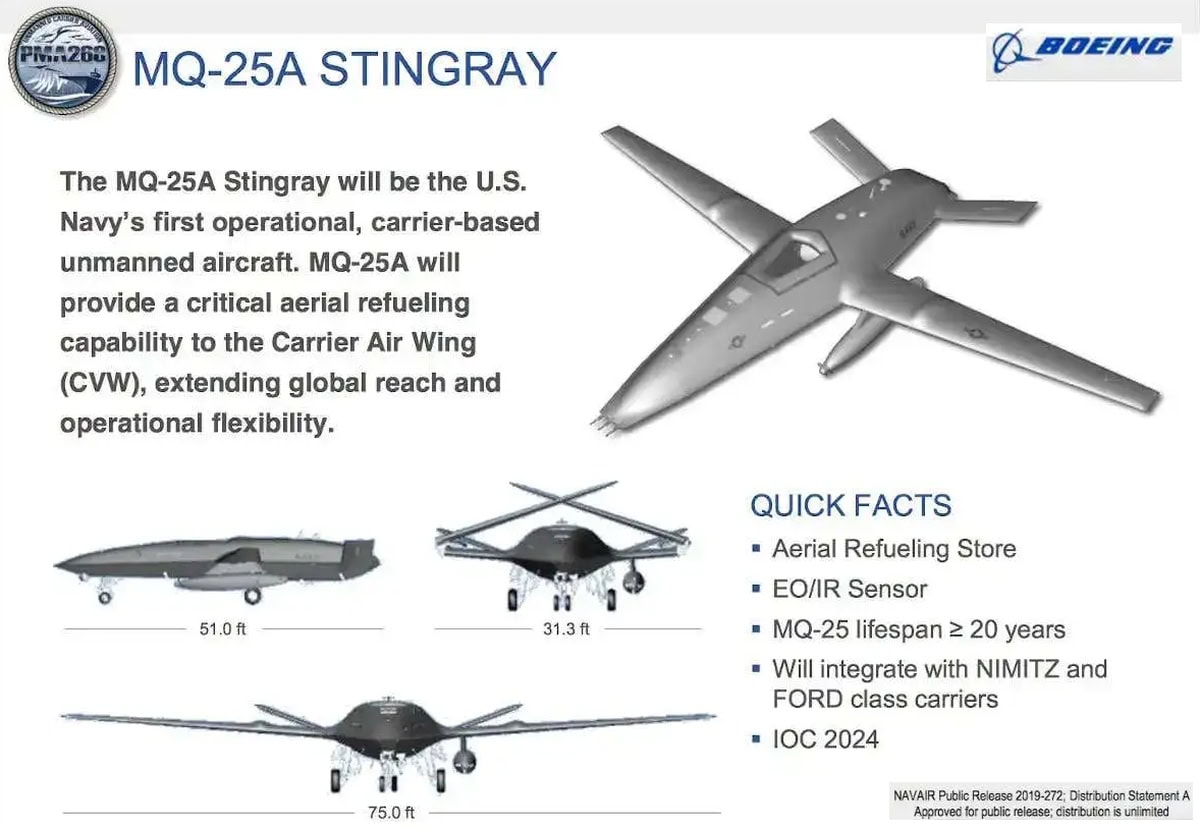
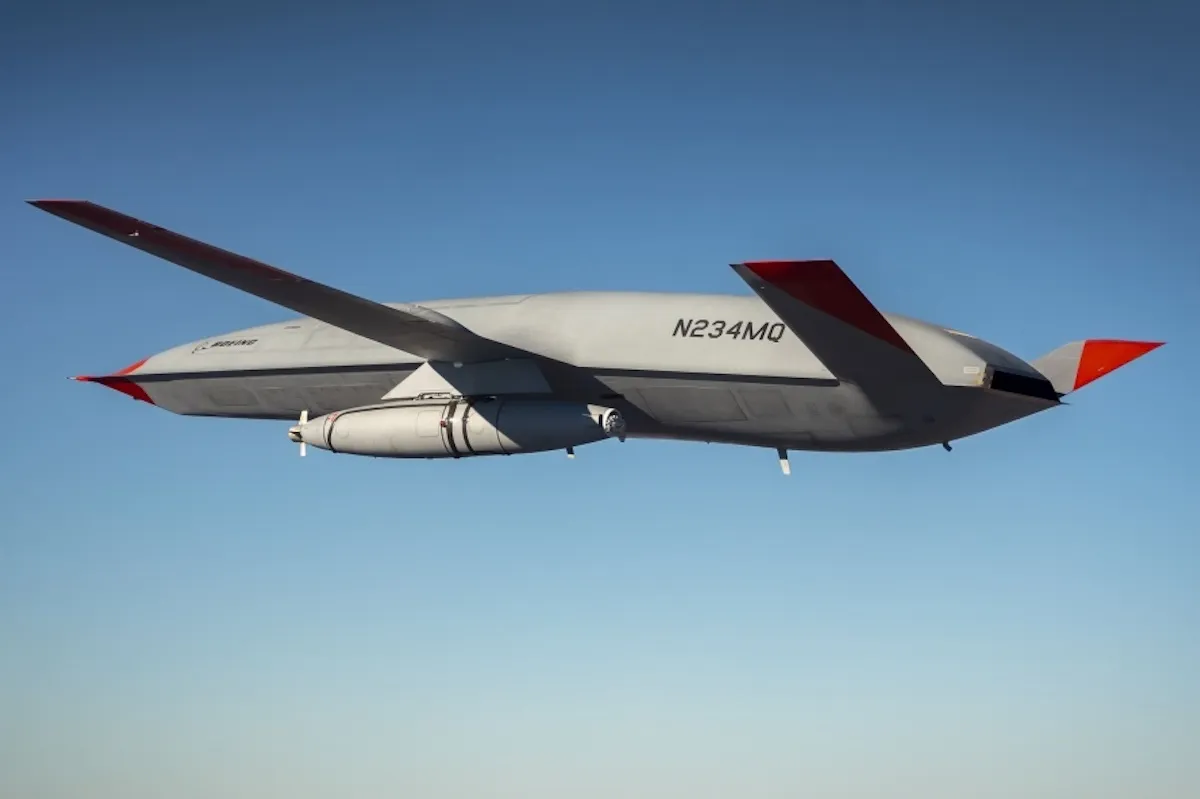
Boeing secured the development contract for the MQ-25 in August 2018, beating out competitors like General Atomics and Lockheed Martin. The company’s winning design utilized a traditional wing-body-tail configuration, which stood in contrast to the flying-wing designs proposed by other industry players. This choice prioritized reliability and integration with current carrier operations. The prototype, known as T-1, successfully completed its maiden flight in September 2019. Since then, the program has moved through a series of rigorous testing phases, including successful mid-air refueling demonstrations with an F/A-18F Super Hornet, an E-2D Hawkeye, and an F-35C Lightning II, proving the drone's ability to integrate seamlessly with the existing carrier air wing.

Technically, the MQ-25 is powered by a single Rolls-Royce AE 3007N turbofan engine, a derivative of the engine utilized in the MQ-4C Triton. While the aircraft is not as stealthy as a dedicated flying-wing strike platform, it incorporates advanced fuselage shaping and a flush engine inlet to reduce its radar cross-section. The drone is designed to deliver approximately 15,000 pounds of fuel to multiple aircraft at a range of 500 nautical miles, effectively extending the combat radius of the Super Hornet by hundreds of miles. Beyond its primary refueling role, the platform is built with modularity in mind, featuring hardpoints that allow for future integration of sensors or even offensive weaponry, such as the AGM-158C Long Range Anti-Ship Missile.
The organizational structure supporting the Stingray is already taking shape. In October 2022, the Navy established Unmanned Carrier Launched Multi-Role Squadron 10 (VUQ-10) at Naval Air Station Patuxent River, Maryland. This unit serves as the Fleet Replacement Squadron, tasked with developing the maintenance, training, and operational protocols required to integrate the MQ-25 into the fleet. As the program matures, the Navy plans to establish additional operational squadrons, VUQ-11 and VUQ-12, to deploy the aircraft across the carrier fleet. The long-term vision for the program includes a potential fleet of 72 aircraft, representing a significant investment in the future of autonomous naval warfare.
The significance of the MQ-25 extends beyond its immediate utility as a tanker. It serves as a critical bridge to the next generation of carrier-based aviation, including the future F/A-XX program. By mastering the complexities of launching, recovering, and operating autonomous systems from the deck of a moving aircraft carrier, the Navy is laying the groundwork for more advanced unmanned strike platforms. The MQ-25 is not merely a support asset; it is a proof-of-concept for the future of the carrier air wing, demonstrating that unmanned systems can provide the flexibility, reach, and lethality required to maintain maritime superiority in the 21st century. As the program continues to advance toward full operational capability, it stands as a testament to the Navy's commitment to modernizing its force through cutting-edge technology and strategic innovation.
Latest News


