UAP Propulsion Technologies
The study of Unidentified Anomalous Phenomena has evolved from anecdotal observation into a rigorous investigation of the physics required to achieve performance characteristics that defy conventional aerospace engineering. Modern reports frequently detail objects capable of instantaneous acceleration, hypersonic speeds devoid of sonic signatures, and the ability to operate seamlessly across air, water, and vacuum environments. These maneuvers suggest a departure from traditional momentum-based propulsion, which relies on the expulsion of mass to generate thrust. Instead, theoretical models for these craft point toward the manipulation of the fundamental fabric of spacetime and the utilization of quantum vacuum energy, effectively bypassing the limitations imposed by the Tsiolkovsky rocket equation.
Gravitational field manipulation stands as a primary candidate for explaining how these craft move without traditional engines. By leveraging the principles of General Relativity, which posits that gravity is a curvature of spacetime rather than a simple force, researchers theorize that a vehicle could generate its own gravitational well. By creating a high-energy electromagnetic field, perhaps through the use of rotating superconductors or plasma, a craft might induce a localized distortion. This would allow the vessel to essentially surf on a wave of spacetime, falling forward continuously. This mechanism also addresses the problem of inertia, as the craft and its occupants would exist within a self-contained gravitational bubble, experiencing freefall rather than the crushing G-forces that would otherwise destroy a physical structure during high-velocity, right-angle turns.
The Alcubierre drive represents another sophisticated framework for understanding superluminal travel. First introduced as a mathematical model in 1994, this concept suggests that space itself can be manipulated to facilitate movement. By contracting the fabric of space ahead of a craft and expanding it behind, the vehicle remains stationary within a flat region of spacetime known as a warp bubble. Because the ship is not moving through space but is instead carried by the expansion and contraction of space itself, it does not violate the local speed-of-light limit. While early iterations of this theory required energy amounts equivalent to the mass of the observable universe, recent refinements suggest that oscillating the bubble wall could reduce these requirements to more manageable levels, though the need for exotic matter with negative energy density remains a significant engineering hurdle.
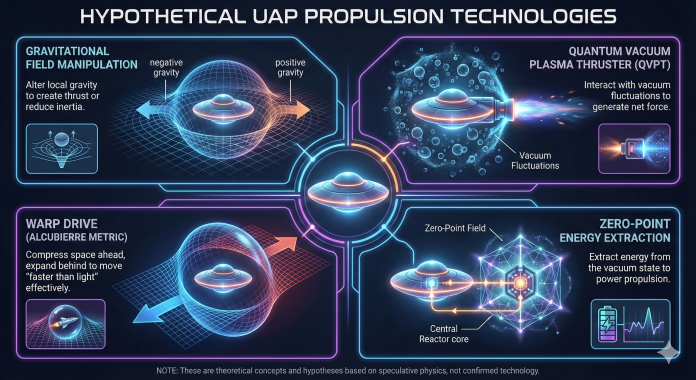
Quantum Vacuum Plasma Thrusters offer a third potential propulsion pathway, shifting the focus from spacetime geometry to the energetic properties of the vacuum itself. Quantum mechanics teaches that a vacuum is not truly empty but is a dynamic sea of virtual particles and zero-point fluctuations. A thruster operating on this principle would interact with this background energy, effectively using the quantum vacuum as a reaction mass. If a vehicle could polarize or organize these fluctuations using high-intensity electromagnetic fields, it might achieve propulsion without the need for onboard propellant. While critics argue this approach challenges the conservation of momentum, proponents suggest that the vacuum possesses its own momentum density, allowing for a propellant-less exchange that would explain the glowing plasma sheaths often observed around anomalous aerial objects.
To sustain these high-energy propulsion systems, traditional chemical or nuclear fission power sources are insufficient. This necessitates the exploration of Zero-Point Energy extraction, which seeks to harvest the background energy of the universe. The Casimir effect provides empirical evidence that this energy exists, as it creates measurable pressure between metallic plates in a vacuum. If technology could be developed to tap into this infinite reservoir, it would provide the terawatts of power required for gravitational field generation or the maintenance of a warp bubble. Within the framework of stochastic electrodynamics, some theorists suggest that inertia itself might be an electromagnetic drag force caused by movement through this zero-point field, implying that a craft could potentially reduce its own mass by creating coherence in the surrounding vacuum fluctuations.
The transition from theoretical physics to functional hardware requires advancements in material science that are as complex as the propulsion models themselves. To direct the electromagnetic fields necessary for warping spacetime or interacting with the vacuum, engineers look toward metamaterials—structures engineered at the atomic level to exhibit properties not found in nature. These materials, which may include layered bismuth and magnesium or structures with specific isotopic ratios, could act as waveguides for high-frequency energy. By trapping and resonating energy, these materials might provide the structural integrity and field-focusing capabilities required to withstand the immense stresses of non-Newtonian flight.
Ultimately, the study of these propulsion technologies provides a structured lens through which to analyze UAP data. While these concepts remain speculative and push the boundaries of current human capability, they offer a coherent explanation for the anomalous flight patterns documented by military and civilian observers. The convergence of gravitational manipulation, warp metrics, and quantum vacuum interaction suggests a future where aerospace travel is defined not by the combustion of fuel, but by the mastery of the environment in which the vehicle operates. Achieving this reality will require unprecedented breakthroughs in high-energy physics and the ability to engineer matter at the quantum scale.
Latest News


